Shortpass vs Longpass Filters: Which One Do You Need?
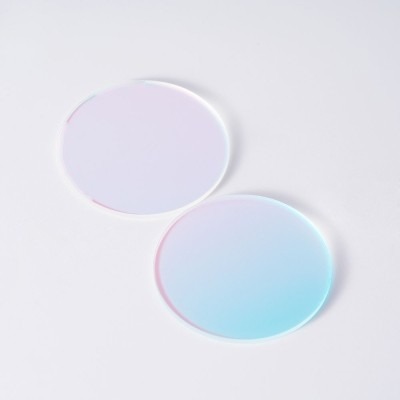
Shortpass and longpass filters are the two fundamental edge filters. They do opposite jobs: a shortpass filter transmits wavelengths below a cut-off and blocks those above it, while a longpass filter transmits above a cut-on and blocks below. Choosing between them is usually obvious once you know which part of the spectrum you want to keep.
Start with the signal you care about. If you are detecting a short-wavelength emission against a longer-wavelength background — for example a blue fluorophore excited in the UV — you want a longpass or bandpass combination that passes the blue and rejects the excitation. If instead you need to remove infrared light from a visible camera, a shortpass filter that blocks the IR is the answer.
Direction matters in real systems. Our SP460 shortpass filter passes light below roughly 460 nm and is paired with an AR layer to suppress secondary reflections. Our LP590 longpass filter does the reverse, passing light above 590 nm.
Cut-off accuracy and steepness are the key specs for both types. Steepness describes how quickly transmission falls from the passband to the blockband, often measured as the distance between 80% and 10% transmission. A steeper edge lets you separate closely spaced wavelengths; a softer edge is cheaper but needs more spectral gap.
Blocking depth is equally important. Look for OD 4 or higher in the blocked region, especially if the light you are rejecting is much brighter than the signal you are measuring. A weak fluorescence signal next to a strong excitation line demands deep blocking at the laser wavelength.
Angle of incidence shifts the edge for both families. As the beam tilts, the cut-off or cut-on moves toward shorter wavelengths, and s- and p-polarisation can separate at steep angles. Keep edge filters near normal incidence where possible, or request the curve at your actual angle.
Substrate and coating durability follow the same rules as other filters. Borosilicate glass suits most visible work; fused silica is preferred for UV or high-power use. Hard ion-assisted coatings survive cleaning and humidity far better than soft films.
Application examples clarify the choice. A qPCR instrument separating emission channels uses shortpass filters such as the SP490 filter. A fluorescence microscope collecting a red emission uses a longpass like the LP500 filter. Infrared imaging that must reject visible light relies on the opposite approach.
Both families also appear in coloured glass form. The CB535 yellow filter is essentially a longpass made of coloured glass — rugged and inexpensive, though with a softer edge and moderate blocking compared with thin-film filters.
If you are still unsure, tell us the wavelengths you want to pass and reject, your detector range, incidence angle and quantity. We will recommend a standard shortpass or longpass part, or quote a custom edge filter built to your specification.