Dielectric vs. Metal-Coated Mirrors: Which One Do You Need?
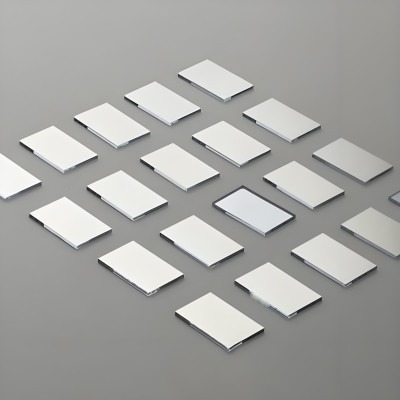
Mirrors look simple, but the coating underneath the glass determines almost everything: how much light is reflected, over what bandwidth, how much power it can take and what it costs. The two dominant technologies are metal-coated mirrors and dielectric (multilayer) mirrors. Understanding the trade-offs lets you specify the right one the first time.
Metal-coated mirrors use a thin layer of aluminium, silver or gold deposited on a substrate. Aluminium covers the UV to near-IR with roughly 85–92% reflectivity; silver reaches 95–98% in the visible and near-IR but tarnishes; gold exceeds 98% in the IR but absorbs in the blue. Their defining advantage is breadth — one mirror works across an unusually wide spectral range and is largely insensitive to angle of incidence.
Dielectric mirrors stack alternating high- and low-index thin-film layers. By controlling layer thickness, reflection can exceed 99.9% at a design wavelength — far beyond any metal. Our silver-coated mirror and gold-coated mirror represent the metal family, while laser steering mirrors are typically dielectric for high reflection at a specific line.
Bandwidth is the key difference. A metal mirror reflects broadly but modestly; a dielectric mirror reflects intensely over a narrow band (often just tens of nanometres, or a defined 'hot mirror' band). If your source is a single wavelength — a laser diode at 905 nm, for example — a dielectric designed for that line wins decisively. If you need one mirror for a white-light or tunable source, metal is safer.
Damage threshold matters in high-power systems. Dielectric coatings generally withstand higher fluence because the films are dense and the field is distributed across many layers. Metal films absorb more energy at the surface and are more prone to laser-induced damage. For pulsed lasers, always check the LIDT at your pulse width and repetition rate.
Angle and polarisation also shift performance. Dielectric mirror reflection bands move toward shorter wavelengths as incidence angle increases, and s- and p-polarisation can diverge at steep angles above 45°. Metal mirrors are more forgiving here. If your beam hits the optic at 45°, request the curve measured at that angle.
Durability and environment tip some decisions. Protected silver and hard dielectric coatings tolerate humidity and cleaning better than bare aluminium or soft films. In an outdoor or industrial sensor, specify a protected or hard-coated version — see our mirror range for options.
Cost is the final factor. Metal mirrors are cheaper and widely stocked in standard sizes, which suits prototypes and general-purpose beams. Dielectric mirrors cost more but pay for themselves where every photon counts or where a high-power beam would destroy a metal film.
Application examples make the choice concrete: a fluorescence instrument steering a 488 nm beam wants a high-reflectivity dielectric; a broadband spectrometer fold mirror wants protected silver; an IR thermal system wants gold. Matching the coating to the source and environment is the whole game.
Still deciding? Send us your wavelength or wavelength range, incidence angle, polarisation, beam power and aperture. We will recommend a standard mirror or quote a custom-coated part with a measured reflectance curve.