How to Choose the Right Longpass Filter for Your Application
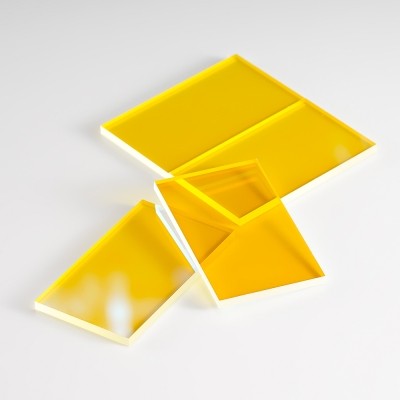
A longpass filter transmits light above a specific cut-on wavelength while rejecting everything below it. It is the workhorse of fluorescence microscopy, laser systems and spectral detection — and one of the most frequently mis-specified components in an optical train. Choosing correctly comes down to four parameters: cut-on wavelength, transmission, out-of-band blocking and substrate.
Start with the cut-on wavelength. It should sit just above the emission you want to pass and comfortably above the excitation you need to reject. A useful rule is to leave at least a 20–30 nm gap between the excitation line and the cut-on edge. Remember that the cut-on shifts toward shorter wavelengths as the angle of incidence increases, so account for the geometry of your beam — a 45° mount can move the edge by several nanometres.
Our LP590 longpass filter is a typical visible-range part, with a cut-on near 590 nm and 90%+ transmission in the passband. For microscopy, the LP500 microscopy filter is optimised for common fluorophores in the green-to-red range.
Next, examine transmission and blocking together. A good hard-coated filter delivers 90% or better peak transmission while holding OD 4 (10⁻⁴) or deeper in the stopband. Peak transmission is easy to advertise; blocking is where cheap filters fail. When you detect weak fluorescence, out-of-band leakage — not peak transmission — is usually the limiting factor.
Blocking is specified in optical density: OD 2 transmits 1%, OD 4 transmits 0.01%, OD 6 transmits one part per million. For a bright excitation source and a weak signal, aim for OD 5 or 6 at the laser line. Ask your supplier for a measured transmission curve, not a typical curve, if the measurement matters.
Then consider the substrate. Borosilicate glass is economical and suitable for most visible applications. Fused silica is the right choice for UV operation, high-power lasers and applications demanding low autofluorescence or high thermal stability. Our longpass filter range includes both substrate options across cut-on wavelengths from the visible into the NIR.
Coating technology matters just as much. Ion-assisted deposition (IAD) produces dense, durable films that tolerate repeated cleaning and humid environments. Soft evaporated coatings are cheaper but scratch easily and drift with humidity. For any production instrument, hard-coated is the safer long-term decision.
Do not forget the mechanical and environmental details: filter diameter, thickness, clear aperture, parallel surface requirement and the mounting orientation. In a converging or diverging beam, a thicker substrate introduces more chromatic aberration and beam displacement — keep the filter near a collimated section of the path where possible.
Beauty and medical devices have their own requirements. The LP560 beauty-device filter and LP550 IPL filter are designed around intense pulsed-light sources, where both cut-on accuracy and laser-grade damage threshold are critical.
For imaging beyond the visible, the LP890 infrared filter extends the same design approach into the NIR. Always match the filter to your detector's spectral response — there is no benefit in passing wavelengths your sensor cannot see.
If you are unsure where to start, send us your excitation wavelength, emission peak, detector range, angle of incidence and quantity. Our engineers will recommend a standard part or quote a custom longpass filter built to your specification — with a measured curve supplied for every batch.