Dichroic Mirror vs Beamsplitter: Understanding the Difference
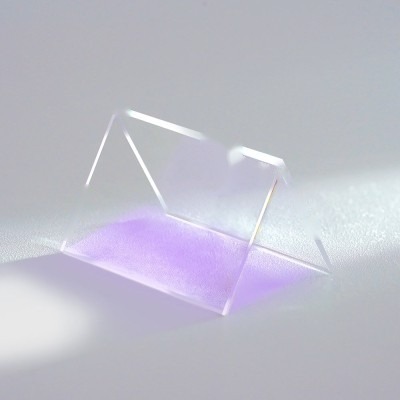
Dichroic mirrors and beamsplitters often look alike — both are flat plates that sit at 45° in a beam — but they do fundamentally different jobs. Understanding that difference prevents one of the most common mistakes in optical layout.
A dichroic mirror separates by wavelength. It reflects one band of colours while transmitting another. In a fluorescence microscope, for example, it reflects the excitation light toward the sample and lets the longer-wavelength emission pass through to the detector. Our fluorescence dichroic mirror is designed for exactly this role.
A beamsplitter separates by power, not colour. It divides an incoming beam into two parts with a defined ratio — 50:50, 20:80 or 40:60 — regardless of wavelength across its operating band. A 50:50 beamsplitter sends half the light each way; a 20:80 beamsplitter sends 20% one way and 80% the other.
The coating is what makes the difference. Dichroic mirrors use a longpass- or bandpass-like multilayer designed to reflect one spectral region and transmit another, with a sharp transition. Beamsplitters use a partially reflective coating engineered for a specific intensity ratio and often a defined polarisation behaviour.
Polarisation is a bigger deal for beamsplitters than most people expect. A standard plate beamsplitter reflects s- and p-polarised light differently, so at 45° the split ratio can drift with the polarisation state of your source. A polarising beamsplitter exploits this deliberately to separate polarisations completely.
Angle sensitivity differs too. Dichroic mirrors are designed for a specific incidence angle, usually 45°; change the angle and the transition wavelength shifts. Beamsplitters also specify a design angle, and the split ratio can change outside it. Always operate these optics at their stated angle.
Choose a dichroic mirror when your goal is spectral separation: combining or separating colours, as in fluorescence, confocal microscopy, projection or laser beam combining. Our range includes specialised types such as the blue-transmit / green-reflect dichroic for RGB systems.
Choose a beamsplitter when you need to sample or divide light regardless of colour: splitting a beam into two imaging paths, monitoring a fraction of a laser with a inspection beamsplitter, or building an interferometer.
Some applications use both. A fluorescence system may use a dichroic to separate excitation from emission and a beamsplitter to send part of the emission to a second detector. In those cases, match the coatings so neither optic steals light the other needs.
Tell us your wavelengths, polarisation, incidence angle, split ratio or spectral transition, and beam power. We will recommend a standard dichroic mirror or beamsplitter, or design a custom coating for your exact layout.